Dr. Martin Luther King, Jr. was one of the greatest civil rights activists of all time. He fought for equal access to opportunities for all Americans, regardless of race. One major issue of his time was equality in education. Though education looks very different than it did in Dr. King’s time, injustice and inequality still exists in schools.
During the Civil Rights Era, activists like MLK were fighting for black children to be able to attend the same schools as white children. At the time, the laws of the United States said that schools could be segregated by race, so long as they were equal in the quality of education they provided. This was known as “separate but equal.”
However, as Dr. King and others knew, there really is no such thing as separate but equal. Schools for white children had better facilities, newer textbooks, and more money. Martin Luther King, Jr. believed that all children should have the same resources in their schools. He was ultimately assassinated for his part in the Civil Rights Movement.
But what if Dr. King was still alive today? What would he think of our education system? And what would he say about digital inequity?
Digital inequity is the unequal distribution of digital resources and availability. This inequality disproportionately affects families of color and families living below the poverty line. Black and Latino students are far more likely to live in homes without internet access, as are students in families with an annual income below $50,000.
Without access to the same resources, these students cannot get the same education as their wealthier White peers. Just as MLK fought against separate but equal schools in the 1950’s, activists today must fight against an unequal system.
If MLK were alive today, he would undoubtedly tell us we must ensure that low-income children of color have the same digital tools as other children. Digital inequity, while it may not sound like a civil rights issue, is indeed. The fight for equality is about much more than allowing students of different races to attend school together. At its heart, it’s really about giving everyone equal opportunities and equal access to resources that will help them succeed.
Perhaps we need a modern-day MLK to address the issue of digital inequity. Otherwise, the digital divide will continue to be another way that poor students of color are placed at a disadvantage.
What do you think MLK would say about digital inequity?
If you want to market to the P-20 arena’s most influential audience, then The Edvocate is your publication of choice. The Edvocate is the fastest growing online destination for the P-20 market. Our readers are:
Highly educated and place a premium on quality education
Professionally upwardly mobile
Socially committed men and women engaged in their communities
Decision-makers in both the public and private sector
Passionate advocates for equality, access and opportunity for all
Because the editorial content is credible, relevant and unique to The Edvocate, our readers trust and rely on us. When great value is attached to a publication’s editorial, that value is also passed on to the advertising messages found within that publication. This makes The Edvocate the perfect medium to communicate in and reach a unique, target audience.
Readership
160,000 unique visitors per month, 340,000 visits per month, and 4,800,000 million page views per month.
Newsletter
135,000 opt-in subscribers and growing.
Online Display Ads, Advertorials, Sponsored Articles, etc.
Whether you want branding, lead generation, a call to action, thought leadership, or any combination of these results, we have programs that can meet all of your marketing needs. Click here to access our media kit. If you have any questions, contact an Ad Manager at 601-630-5238 or send an email to advocatefored@gmail.com.
Product Reviews
Would you like The Edvocate to review your education related product? Contact us for more details. Because of the time consuming nature of the review process, we charge a fee to conduct product reviews. The fee depends on the complexity of the review. Email us for a quote.
_This article is a part of The Conversation’s series on unique courses. For other articles in this series, read here and here. _
Today’s college students may benefit from an exciting array of subjects to study. But they seem to miss the most important education of all: how to relate their specialization to others in an increasingly interconnected world.
The National Academy of Engineering has categorically stated that today’s engineers need to be more than individuals who simply “like math and science.” They must be “creative problem-solvers” who help “shape our future” by improving our “health, happiness, and safety.”
And in 2001, the engineering accreditation body ABET added a new criterion so as to ensure that students get “the broad education necessary to understand the impact of engineering solutions in a global, economic, environmental, and societal context.”
The point is that the connections between humanities and science have been lost in today’s separation of disciplines. Indeed, a recent report by the American Academy of Arts and Sciences discovered that humanities and STEM (Science, Technology, Engineering and Mathematics) training majors largely dwell in different silos.
So, where and how did we lose our way? And how can educators and institutions change things?
If the interdependence of science and the humanities were more generally understood, men would be more likely to become masters of their technology and not its unthinking servants.
These founders, hailing from leading universities as well as the US Atomic Energy Commission, IBM Corp and New York Life Insurance, knew that connecting the humanities and sciences helps us make informed judgments about our control of nature, ourselves and our destiny.
Connecting the humanities and science helps us make informed decisions. Phillip Barron, CC BY-NC
But, since the 1980s, political rhetoric has emphasized the need for less humanities and more STEM education. STEM is painted as a more profitable investment, in terms of job creation and research dollars generated.
A notable example is the Obama administration’s “Race to the Top” initiative, which both isolates and prioritizes the STEM disciplines from the humanities, arts and social sciences.
This rhetoric is also evident in the creation of separate political education organizations such as the bipartisan STEM Education Caucus founded several years ago by congressional representatives to strengthen STEM education from kindergarten to the workforce.
This separation of disciplines actually hurts education, and it also hurts our ability to innovate and solve big problems.
Connecting STEM with humanities doesn’t just provide the well-rounded education today’s employers want. As the American Academy of Arts and Science’s 2013 “The Heart of the Matter” report observes, connecting these fields is necessary to solve the world’s biggest problems such as “the provision of clean air and water, food, health, energy, universal education, human rights, and the assurance of physical safety.”
So, separating and prioritizing STEM from humanities ignores the fact that we live in a complex social and cultural world. And many different disciplines must combine to address this world’s needs and challenges.
Bringing the disciplines together
To address this gap, four years ago the faculty from materials engineering and liberal arts at the University of Florida began working with the Materials Research Society. We wanted to put together a new course on “materials.”
Why did we choose materials? Because everything is made of them, every discipline studies them and they are tangible (quite literally) to the average freshman.
An interdisciplinary course on materials prepares students for the challenges of the future. Internet Archive Book Images
After all, grade school students still learn about the Stone, Bronze, and Iron ages. The Industrial and Information revolutions revolved around new uses for steel, aluminum and silicon. The human past has been shaped by harnessing and consuming materials and energy.
Materials will be important for our collective future as well. So, we thought, this is the future for which we should be preparing students.
And thus our course, The Impact of Materials on Society (IMOS), was born. Taught by a team of nine faculty from engineering, humanities and social sciences, the course explores the close connection between the “stuff” in our lives and our experiences as social beings.
Students discuss how materials benefit global trade and communication but also risk resource exploitation and political conflict. For example, we depend upon rare earths for our cellphones, iPads and wind farms, but accessing these rare earths from limited sources is not sustainable.
So, some of the questions that the course raises are: what materials do we depend upon in our daily lives? Does this dependence have social consequences? What social relationships form around the production and use of these materials? And how do our current uses of materials affect our ability to discover new uses for them?
Students also discuss the ethical and social aspects of using certain materials. college.library, CC BY
Students are also asked to consider how our values shape our willingness to adopt new technologies. For example, Earl Tupper may have invented Tupperware, but it was Brownie Wise and her home parties with other women who first made his polymer famous!
Each week covers a different material (eg, clay, glass, gold, plastic), its scientific properties, demonstrations, and its past and present impacts.
Working together in multidisciplinary groups, students then contemplate the development of future materials. These include flexible electronic materials that can be used to create wearable sensors that can transmit important information, such as body hydration levels during athletic training. New polymer (plastic) materials made from renewable sources instead of petroleum may have fewer health risks and are more sustainable than today’s plastic cups and bottles.
At the same time, they discuss the ethical and social considerations that might affect the successful production and adoption of these new materials in different contexts.
Gap in education
The course is different from other freshman-oriented courses. It is not a “history course for engineers.” And it is not an “engineering course for humanists.”
It is an interdisciplinary course that uses multiple perspectives to understand materials innovation. A wide range of departments including engineering, anthropology, classics, history, English, sociology and philosophy participate in its teaching.
Students refer to IMOS as a “bridge course” that provides the “connecting dots” between different classes.
And the responses come from students across the different majors. For instance, one engineering major noted, “This class just further proves that you have to understand different aspects of how our world works and not just engineering to be a great engineer.”
Meanwhile a history major observed, “This class gives me a leg up in my other history courses because it reminds me to think about the properties of materials and how they shape our lives.”
These experiences point to a gaping hole in modern education: discipline-specific and general education courses provide important knowledge, but “bridging courses” are needed for students to capitalize upon that knowledge.
To engineer useful technologies, we need to connect scientific study with the cultural competencies of the humanities and social sciences.
Challenges of 21st-century learning
The “Renaissance” ideal was to produce elite men whose broad training prepared them for any endeavor. Thankfully, 21st-century education is more inclusive.
But it still requires intellectual and cognitive flexibility to harness large amounts of data.
This doesn’t mean simply knowing everything, even though we live in the “Age of Google.” Today, students need the ability to make connections across disciplines.
Celebrated innovators such as Einstein, Ada Lovelace and Steve Jobs credit the intersection of disciplines for their inventive thinking.
More boundary-crossing opportunities in higher education can break open the disciplinary silos. And that alone will unleash critical thinking and innovation.
Additional contributors to this article are University of Florida faculty Sean Adams, Marsha Bryant, Florin Curta, Mary Ann Eaverly, Bonnie Effros and Ken Sassaman, and Materials Research Society Outreach Coordinator Pamela Hupp.
Some have argued this is because women are entering male-dominated spaces that are full of misogynists.
But in a study that we just published, we show that the cause could be something much simpler: the negative and sexist comments expressed by some men are really just a form of bullying, motivated by the fact that they are perceived as being lower in the pecking order.
Bullying tends to remain a viable strategy when hierarchies exist because it allows individuals to increase their status thereby preventing others from rising above them.
If we look at misogyny from another perspective, could it be a form of inter-sexual bullying that arises when women compete against men? Men who are afraid of losing their position in a hierarchy to a woman may be lashing out, leaning on the most stereotypical traits because they have the effect of reducing a woman’s power.
We set out to explore this idea – using video games.
Playing for the answer
Video games can be a bastion of sexist imagery and aggressive posturing. But unlike most inter-sexual competitive scenarios, in video games it doesn’t matter how physically big and strong you are. All that matters is how well you play.
This make them a perfect place to ask what role hierarchies and perceived status play in inter-sexual aggression.
To do this, we used Halo 3, a futuristic shooter where teams of four players compete against one another in an attempt to kill their opponents as often as possible.
The game records exactly how many kills each player achieves and how often they die. If they’re playing very well, it means they’re likely outperforming others and helping their team. On the other hand, if they’re performing poorly, not only are they likely to be at the bottom of the leaderboard, but they’re also dragging down their team.
Additionally, an algorithm determined by the game’s developers, Bungee, calculates a measure of player skill determined by their long-term performance – analogous to social status in this context.
Since we can record everything that each teammate says during a game, we can also correlate the frequency of positive and negative statements players make towards teammates.
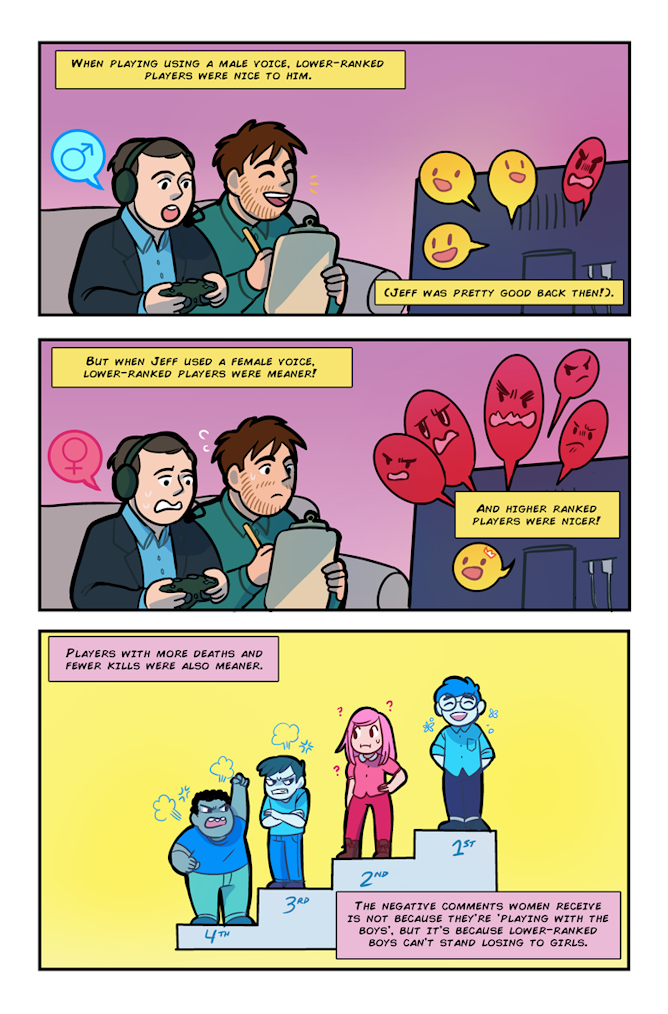
Next comes the fun part. By using a recorded male or female voice, we can see how players respond to teammates of each sex based on their own performance. Jeff played 126 games of Halo 3 using this structure. All the other speaking players on his team were men.
Gaming isn’t always relaxing, and sometimes that tension can spill over into harassment of other gamers. Maryam Abdulghaffar/Flickr, CC BY
What’s in a voice?
What we found was that Jeff’s teammates who died more often generally made more positive comments towards Jeff. And their performance, good or bad, had no effect on the number of negative comments they directed towards him.
In contrast, when Jeff used a female voice, he received many more negative comments, particularly from players who were performing poorly.
This suggests that men behaved according to a social hierarchy. When they were performing poorly – i.e. they were lower status – they did not challenge a male-voiced teammate, but they did challenge a female-voiced one.
This was supported by our results exploring skill level –- our proxy for an individual’s position in the hierarchy. Skill level didn’t affect how men behaved towards another man, but men lower in skill were less positive in the female-voiced treatment.
Interestingly, higher-skilled men were more positive towards women, but not men.
The predicted relationship of the number of negative comments male players made towards a female- or male-voiced teammate as a function of their skill level.
Who wants a beta male anyway?
The take-home seems to be that, just like bullies, the men most likely to have their position in a hierarchy usurped by a woman turned out to be meaner.
When you look at this situation from an evolutionary perspective, some of the reasoning becomes more clear. Since a man’s mating chances are better determined by his status than his looks, if a woman is usurping a man’s status by outperforming him, it means that he is less likely to be attractive to a potential mate, especially one that is higher than him in the hierarchy.
Although it’s unlikely that men are thinking about mate attraction when playing Halo 3, we think the increased negativity directed towards higher status women by some men is an unconscious response to having their masculinity challenged by a woman. “Losing to a girl” is still deemed unacceptable by many men as it can reduce their status in the eyes of others – both men and women.
The hostile aspects of gaming culture could thus be explained as the search for, and maintenance of, status. One way to ensure that a man doesn’t lose to a woman is to keep women from competing by making them feel unwanted in that environment.
Perhaps this perspective may also help explain the misogyny we see when women enter some male-dominated fields. The aggression may come from lower status men that are trying to keep women out by employing sexist bullying in order to ensure they don’t lose status in the presence of their male colleagues.
The one thing that is still quite intriguing is the result that the highly skilled men were more supportive towards women than men.
Are these nice guys behaving this way because they have nothing to fear and are applauding a woman’s entry into the field? Or is it because they have nothing to fear, for now. Would they become more aggressive if they felt threatened? Or are they comfortable in their ability that losing to a woman wouldn’t bother them.
These are questions we don’t know the answer to yet, but we’re willing to play a few thousand games online to find out.
Interested in reading the study in a different format? Then take a look at the comic below! Click on the preview to see the full page. Art by Savanna Ganucheau.
Michael and Jeff will be on hand for an Author Q&A between 10 and 11am AEST on Friday, July 17. Post your questions in the comments section below.
Most open letters are written as a passive criticism or open critique of a large institution. I have no wish to be passive in my critique and observations. They are intended to spur conversation and reflection. These are the tools of our trade as teachers. I was hired to critique and foster reflection.
After studying and researching in your administrative offices over the previous year, you have embraced personalized learning as a targeted result, as we deploy technology throughout the district. It is a goal widely acknowledged to be systemic in scope and paradigm shifting by its nature. So with all sincerity, I applaud your willingness to step bravely into a well-reasoned approach to 21st-century learning.
It is widely agreed that personalized learning is also a new pedagogical mindset that must extend beyond the classrooms; that fact pushes forward my primary question “How does the leadership of a personalized learning environment shift itself to accommodate the new network of change?”
As I continue learning to apply a more personalized approach to my teaching. I have found that many of those same skills can be used to reflect and evaluate options. So I have tried here to apply a similar cognitive approach, an open critique and sincere question on eight observations I have noted as my school, and our district has embarked on a journey of blended and personalized learning.
In the classrooms we are, approaching the close of another school year, you at the District offices are approaching the hiring season. As you do so, I would ask that you perhaps take some time to consider the qualities your prize as you develop a leadership team for the future. It is commonly understood that there is a shortage of new teachers in the US, as well as a disconcertingly high number of experienced professionals leaving our classrooms. But that is not the case for program administrators and principals. The number of people earning Masters Degrees’ in educational leadership or seeking an administrative endorsement is higher now than at any time in the past 25 years. According to the US Bureau of Labor Statistics
You have the opportunity to look broadly and consider carefully those that will help lead us through this systemic paradigm shift.
Personalized learning achieved through a blended curriculum keeps students engaged; it pushes them to grow and demands that they understand both themselves as learners and our curriculum as it pertains to their lives. In a very real sense, PL embodies the vision that led so many of us into teaching as a profession. The opportunity to connect not just with a child, but with a child through teaching and learning.
Personalization is full of hard data, human connections and an intricate web of lessons, apps, and projects. Peel back that top layer and the overwhelming nature of the idea begins to surface, PL disseminates the control of the learning within a classroom, the students practicing to take control of their own path. The teacher building supports and taking them away.
That complex dance of adding and subtracting scaffolding while it is being used is being successfully done. But it is severely limited when it has to fall within blocks of time and for a set number of minutes each week.
Where once our administration needed to be skilled at defining, defending and delineating blocks of time we are now asking them to find flexibility within a rigid structure and extra time where the was never enough.
? How do we as a district support the required complexity of a school schedule while still offering the time to rigorously dig deeply into an area of study?
Underneath the popular jargon and interview buzzwords that you will hear, like Grit and Mindset, are classrooms where those life skills are being developed. In those rooms, both students and teachers are failing, examining their efforts and sometimes failing again. Learning to fail and from failure is important for real success.
As an institution, we are built to reward success and admonish failure. As a culture of educators, we are largely populated by those that thrived in that climate exemplifying their own successes and hiding their failures.
? How do we insure ourselves and reassure others that our district leadership understands the role of failure and exploration as we move into a new mindset?
We do not work in an industry where taking chances, innovating or finding a creative alternative is celebrated, least of all at the administrative level. Rather we as a profession, are accurately profiled as safe, steady, stable, predictable types. Our administrators even more so than those of us in the classroom.
We are now in an era where we will need to be inventive, take calculated chances and create new ideas. We will need to look for those traits in our leaders as we move into uncharted paths with impressionable cargo.
? What are the important character trait of a 21st-century school administrator, and how do we ensure that the status quo does not continue to be the status quo?
? How will the changing power dynamic in classrooms impact both our schools and our district as a whole?
One of the most powerful aspects of personalized learning is that it is, out of necessity, powered from the classroom up. Teacher-leaders are the ones moving the bar and setting the standards. Those classroom maestros will need strong support and stronger feedback.
Please remember as you consider the next steps for those that will be leading the dwindling number of magnificent classroom teachers that we are a profession built on the artful combination of personal connections, honest feedback, and transparent agendas with all of our students, not simply those in the most need.
? How can we use our transition into personalized learning, as an opportunity to both support and capitalize on the prowess of our teacher-leaders?
The devices, the web resources, the alignment of lessons and project to a standard, all of these pieces are new and as unfamiliar as they are integral to this shift. As a teacher, I know there is no shame in saying I don’t know, and that I will not be able to master all of those elements of the job I love without support. I am confident and comfortable say that my principal and school as a whole will need support as well.
It is not an uncommon critique to observe that the current structure of our educational system was built with management in mind rather than support and growth. Nor is it an uncommon refrain for teachers ask for support. It is uncommon, however, to have the opportunity to create the needed change.
? What structures of support can we enhance or establish to best help our schools thrive as centers of blended and personalized teaching?
? How do we find a way to structure and support creativity while still managing growth and learning?
If you are overwhelmed by the questions and standards set before you if you feel as though the task is disproportionate to the tools available. Please know that I, and every classroom teacher, that works for you is familiar with those insecurities. We grapple with them every fall, we understand, from experience I can tell you that the while the challenge never fades the overwhelmed feeling does.
With sincere thanks for all that you do to move us forward,
If all required learning materials, including textbooks, were provided to all students on or before the first day of class, the average price per student of learning materials would drop and students would be more successful.
Then why is it the vast majority of college students do not come to class with required content on the first day of class, and a significant number never get their core textbooks at all?
First, because required doesn’t actually mean required in higher education. Is this because colleges and faculty do not care about the success of students? Of course not. Ask any academic leader on a college campus if students would be better off if they had all required learning materials and the answer will be a resounding, YES. Faculty spend valuable time planning their courses and choosing resources; however, in the end, after all that work, most institutions and most professors are willing to leave it up to the student whether or not they actually acquire and engage with the content.
The actual content domain to be mastered in the course is, astoundingly, practically the only thing left to the whims of student choice. It is absolutely required that all dental students MUST have an articulator for class (an instrument for studying tooth and jaw). You cannot pass; you cannot even come to class, without one. But is it absolutely required that students possess the material detailing the various bones, muscles, nerves, and tendons involved? It is not.
Traditionally, little thought was given to the price of the resources or whether the students will purchase them. Why didn’t professors pay attention to price if they are so carefully choosing these resources?
One reason is that resources used to be reasonably priced and another is that professors don’t have to pay for the content. Economists call this the Principal Agent Problem, meaning that the decision-maker (agent/faculty) is not the one affected (principal/student). This doesn’t mean that faculty don’t care about the price of textbooks, it is simply that it has not been the predominant factor in their equation for determining course materials. Certainly some instructors care strongly about cost, but the means they use to address the problem—think third-generation scans of articles, not properly licensed, or two copies of a book in the library for a class of 400 students—reduce the quality of instruction and are in the long term not effective against cost.
What is preventing all colleges and universities from including the course materials in the cost of the course given that is guaranteed to cut student costs of learning materials and increase student success?
Ironically, one reason is that institutions are sensitive to the perception of adding any cost tied directly to the institution. The cost of tuition has more than doubled (measured in constant dollars) over the past 30 years and institutions are reluctant to be perceived as increasing student costs. However, students spend an average of $1300 per year on textbooks and supplies alone. That’s the equivalent of 39 percent of tuition and fees at a community college, and 14 percent of tuition and fees at a four-year public university on average. Including textbooks in tuition would save students at least $800 per year, a more than 60 percent reduction in cost.
Rather than consider the total cost of education, which includes required learning materials it is easier to give students a list of “required materials” and leave that decision-making to them on how, when or whether, they get them. While conveniently allowing institutions to wash their hands of the costs of course materials, this model has directly led to the massive increase in cost of learning materials: an 82 percent increase in the cost of textbooks over the last 10 years. This number is more than three times the rate of inflation.
How can this be? The economics are simple. Education publishers invest tremendous resources into the creation of textbooks working with experts in the field – often leading professors – to author, curate, organize and deliver content and assessments in a package designed to facilitate learning. They then sell this print book into the market to students through a variety of channels including student bookstores and online sellers. However, unlike the food these same students may have purchased, that book does not get consumed and most students sell this book back into market. Sure, some students do keep for future reference and I do have a section on my personal bookshelf dedicated to titles from my formal studies. However, a quick review of that shelf will find that most of these were actually used when I purchased them.
The other issue here is scale. A textbook, regardless of how widely adopted, has a limited market. A New York Times bestseller has to hit an average of 9,000 copies a week to make the list. That is about 500,000 books a year. For a book to reach Amazon’s top seller list, that number is about 3,000, which equates to approximately 150,000 copies a year. A college textbook would be lucky to sell one-tenth of that number, concentrating the development cost across fewer anticipated sales.
This textbook, for which the publisher received revenue one time, may then be resold another six times without the publisher receiving any revenue. Making matters worse, rental textbook programs have grown significantly over the past five years as well, reducing the sell through of “new” titles even further. As a result, publishers have to maximize the price of their initial sale to cover the lost sales. It also reduces the number of years between new editions, since a new edition represents another opportunity for publishers to make a sale again before that title enters the used and rental markets.
When publishers sell new textbooks at absurdly high prices, it is easy to make them out to be the greedy villain in this story. However, publishers are just responding to the economic realities of their business and they are ready to participate in a better solution.
That solution is absurdly simple. Breaking the cycle and lower the total cost of education by eliminating the print textbook. Do this and students will benefit both economically and educationally.
With a digital learning solution, there is no used or rental market, so the publisher gets paid for every student and can significantly lower the price of the content. You might say, digital textbooks are available today and students can simply choose them and that is true. However, the retail price of digital textbooks is simply not as competitive with rental and used. Again, this is due to the market…if institutions ensured every student had access to the content, the publishers would make the sale on every student, and they can significantly lower the cost of the content. Education publishers can then go back to what they were originally founded to do: compete to create the most effective learning solutions.
A quick note about Open Education Resources (OER), which have been touted as an answer to the high cost of course materials. Without question OER materials can significantly lower the cost to students. However, no materials should be adopted primarily because of cost. We want students to get the best materials available, be they OER or commercially produced. Students shouldn’t receive inferior materials just because they are cheap or free.
By far the most important reason to provide students with the required materials they need is to level the playing field for success in college. According to the last data from the National Center for Education Data, the six-year graduation rate for first-time, full-time undergraduate students at four-year degree-granting institutions is 60 percent. Thirty-nine percent of those enrolled in two-year programs complete within three years. These statistics are worse for students who are the first in their family to go to college or have financial challenges. The high cost of course materials is particularly egregious for lower income and disadvantaged students. Fifty-two percent of those whose families earn less than $50,000 feel that avoiding or delaying purchasing the materials negatively impacted their grades, compared to just 39 percent of those whose families make more.
Beyond lowered costs and assuring the students get their materials, there are many other educational benefits to providing digital learning materials on or before the first day or class. Once all students and faculty are in a digital learning environment, the content can evolve from static pages to interactive learning solutions providing formative and summative feedback opportunities as well as insight into student learning behaviors. There are fantastic digital learning solutions available and in use today that I will discuss in a future blog post.
What would it take to implement a program that significantly lowers the cost of learning materials and ensures all students get them at the beginning of the course? Nothing more than institution to simply say yes to a course fee model. The federal government has responded to the rise of these programs and by publishing new rules that allow any institution to include learning materials in a course provided students are given the option to opt-out on a per course basis.
These programs have been implemented in pockets around the country and VitalSource is powering them at more than 400 institutions around the United States saving students more than $100,000,000 in the past 12 months. To break that down a little bit, students are saving an average of $60 per title and we delivered more than 1,700,000 titles through inclusive access programs at traditional 2/4-year programs. Our technology powered these savings through our VitalSource Access program, but also through programs run by some of our partners Barnes and Nobles Education, Pearson, Follett, and more than 20 other partners serving higher education institutions.
Beyond the cost savings, all of these students received the content on the first day, and their faculty and institutions now had brand new insights through our analytics product as to exactly what each student was doing with the content. Print can’t do that, and students choosing digital won’t either.
Everything is in place to improve learning and cut student costs. If just half of all universities implemented these programs across campus, no less than $1 billion dollars could be cut from student costs. What are we waiting for?
Just as students have to learn how to be good citizens within their community, they need to know how to behave and be a positive part of the digital community. Digital citizenship is an important responsibility that everyone needs to understand as it encapsulates as many aspects of behavior and actions as physical interaction does. Depending on the age of the student, there are different areas that you can focus on. As the student’s age, you have to ensure that their understanding and ability to be a good digital citizen continues.
Starting with stranger danger and cyberbullying, your students will need to continue to learn about this aspect of technology throughout their educational career.
#1 Seamless Incorporation into the Daily Lessons
The best way to ensure that children understand about digital citizenship is to build it into the daily lessons. By practicing it every day, it becomes second nature, regardless of what age the students are. Nor does it take much extra time or effort since you are already likely working with technology every day.
When your students make presentations, you can highlight copyright and intellectual rights. For younger students, you can highlight issues like plagiarism and citing their research. As the kid’s age, you can begin to ask them how they would like to have their work discussed and used by others. Have them think about how they would feel if someone else were to profit from their hard work, especially if it was done without their consent.
To teach about the importance of being careful online, you can have your student create online accounts for people you are studying in history or literature. The pages they create will teach them to think about the people and characters from a new perspective, as well as showing them how to be respectful of others when chatting on those pages.
#2 Find the Right Resources
This suggestion is probably the most challenging, but not for a lack of resources. With the rapid pace that technology changes, new tools and resources are constantly being posted. One of the most beneficial to educators is the forums and discussion boards where teachers, administrators, professors, and others in the industry chat about their experiences and share their ideas.
Keeping in mind that you want to be able to incorporate daily lessons on citizenship, the resources should help simplify the incorporation. Apps provide an excellent way of teaching students at any age range, although it can be difficult to find apps that will work in a school setting. A wealth of devices are also available, although they can be cost prohibitive. Things like Google Cardboard works to keep the cost to a minimum.
Ultimately, collaboration is the best way to find the best resources for your lessons. The more people in education that you chat with, the more ideas you will find to enhance your students’ understanding of digital citizenship.
#3 Focus on Topics Based on Your Students’ Age Group
As you begin to find new and exciting ways of teaching digital citizenship, you may end up getting caught up in the possibilities and forget to consider the children’s age group. Each year of school will require a different approach and level of complexity. You have to keep the goals and expectations appropriate for the age you are educating.
In Kindergarten, the focus will be on issues like stranger danger and how to be safe when using the Internet. First and second graders will need to be reminded of safe practices, but you will also need to introduce topics like cyberbullying so they can learn how to treat others online, and how to react when someone is a bully. You will need forums and boards that you can monitor. As kids reach the age to be able to use Facebook (13 according to the Facebook Terms and Conditions), then you need to introduce concerns about social media and how to behave.
The older the students are, the more challenging it can be because technology frequently targets the older children. Your lessons will need to address the possible problems and resolutions to those problems when new technology and apps appear.
#4 Review Comments Sections of Articles for Other Areas
When you are teaching about a historical figure, a math concept, or science theory, you can use online resources. Once you are done with the main section or video, you can scroll down to the comment section and review what others have said about the section. You will need to make sure to review the comments before you start the lesson to ensure there is nothing inappropriate for the classroom. However, if there is anything that is wrong (without being highly inappropriate or abusive), you can talk to your class about the behavior and how it could be addressed. This makes it easy to cover both the lesson and the daily digital citizenship lesson at one time.
#5 Examine Cyberbullying Stories and Find Solutions
The older the children, the more likely it is they will encounter cyberbullying. The number of stories about cyber bullying is plentiful, and sometimes tragic. You will need to be very careful about what examples you use. For younger students, make sure you use examples that are already resolved so that you know how things ended. You will need to use examples of cyberbullying that had negative results, as well as those that had positive resolutions, regardless of age group.
Be careful about the stories that you use, particularly if you use ongoing cases with older students. Older students will be able to understand the tragic endings, and you cannot entirely avoid them. However, you must be careful about how you teach these examples to ensure that students understand how to combat these situations to avoid the worst possible outcome appropriately.
For all age groups, discussions should revolve around how/why the events are cyberbullying and how the students would react if it happened to them. Make sure to draw parallels to their lives if you notice that some students are beginning to show signs of cyber bullying their peers in discussion boards and forums at the school.
Conclusion
The more people rely on technology, the more important digital citizenship becomes. In the early days, it was like the Wild West where there were no rules and people fended for themselves as best they could. With the rise of the Internet, a digital society began to form, bringing with it a slew of social norms and etiquettes. Many of the behaviors of people in the early days are no longer considered acceptable, but it is not something your students will innately know, especially if they have become accustomed to that sort of behavior. As a teacher, you can begin to instruct students on how to be careful and respectful so that they can enjoy all of the amazing possibilities of the digital age.
**The Edvocate is pleased to publish guest posts as way to fuel important conversations surrounding P-20 education in America. The opinions contained within guest posts are those of the authors and do not necessarily reflect the official opinion of The Edvocate or Dr. Matthew Lynch.**
Bill Shorten’s recent announcement that, if elected, a Labor Government would “ensure that computer coding is taught in every primary and secondary school in Australia” has brought attention to an increasing world trend.
Estonia introduced coding in primary schools in 2012 and the UKfollowed suit last year. US-led initiatives such as Code.org and the “Hour of Code”, supported by organisations such as Google and Microsoft, advocate that every school student should have the opportunity to learn computer coding.
There is merit in school students learning coding. We live in a digital world where computer programs underlie everything from business, marketing, aviation, science and medicine, to name several disciplines. During a recent presentation at a radio station, one of our hosts said that IT would have been better background for his career in radio than journalism.
There is also a strong case to be made that Australia’s future prosperity will depend on delivering advanced services and digital technology, and that programming will be essential to this end. Computer programs and software are known to be a strong driver of productivity improvements in many fields.
Being introduced to coding gives students an appreciation of what can be built with technology. We are surrounded by devices controlled by computers. Understanding how they work, and imagining new devices and services, are enhanced by understanding coding.
Of course, not everyone taught coding will become a coder or have a career in information technology. Art is taught in schools with no expectation that the students should become artists.
Drag and drop
A computer program is effectively a means of automating processes. Programs systematically and reliably follow processes and can be used to exhaustively try all the possibilities.
The languagesused to program computers have evolvedin the 70 years we have been building computers. Interfaces and programming environments have become more natural and intuitive. Language features reflect the applications they’re used for.
What is needed to easily express a business process, scientific equation, or data analysis technique is not necessarily the same as what is needed to rapidly develop a video game.
However, throughout the evolution of programming languages, the fundamental principles have remained the same. Computer programming languages express three essential things:
The order in which a sequence of instructions is performed
A means of repeating a sequence of instructions a prescribed number of times
And tests as to whether or not a sequence of instructions is performed.
While personal preference influences which computer language a programmer uses, there is a greater understanding of which languages work well for teaching introductory programming. For example, Scratchis popular for primary school students and is quick to learn. Alicehas been used to help students quickly build computer animations. Pythonis increasingly used for scientific applications. Visual programming languages – where students can drag-and-drop icons rather than type code – allow for rapid development of simple programs.
At Swinburne University of Technology we run workshopsto introduce school students to program NAO robots. Students use the Choregraphe environment to link robot actions from a library.
Students previously unused to programming can develop interesting robot projects in a couple of days. More sophisticated development of the robot requires students to use a more detail-oriented language, such as Python or C++. The simpler options lead to positive student experience.
Writing and then executing a program gives immediate feedback as to whether you have correctly expressed instructions for the computer. Ultimately, the understanding of how to express concepts so that a computer can perform tasks accurately and efficiently is far more important than the details of the programming language.
Underlying all computer programs are algorithms, which specify in a more abstract way how a task is to be done. Algorithmic thinking – also called computational thinking – underlies computer science, and there has been a growing movement on algorithmic thinking in schools.
The new national curriculum reflects algorithmic processes, and materials are being developed to help teachers with the new curriculum. Victoria has recently developed a new subject for the Victorian Certificate of Education (VCE) entitled Algorithmics.
There are even materials for teaching algorithmic thinking without computers. The Computer Science Unplugged movement, led by Tim Bell and colleagues at the University of Canterbury, has developed resources that teach students concepts through movement and fun activities.
Teaching for the this century
Teaching computer coding in schools is very different from initiatives that advocate for computers in the classroom. I was not, and am still not, supportive of compulsory laptop programs in schools.
The idea is not necessarily to expose students to the technology itself, which is almost inevitable these days with the wide penetration of mobile phones. Rather, students are exposed to the skills needed to develop computer applications.
While IT skill shortages is a contentious topic, there is no doubt that not enough of the best and brightest are studying computer science at university. A significant factor is insufficient exposure to the topic at schools. Teaching coding at schools is aimed at addressing the lack.
It might be said that whatever programming language is taught will be obsolete by the time the students enter the workforce. My experience is that, if taught properly, students can rapidly transfer the principles of one language to another.
In the 19th and 20th centuries, the challenge was to understand the physical world, and harness force and energy. This understanding percolated into the school curriculum. In the 21st century, the challenge is to understand and harness data, information and knowledge. Computer programming is a necessary way of introducing students to these concepts.
Teachers have a lot on their plate when it comes to measuring achievement. Student success is determined by assessments, graded materials and even technological savvy. The consensus seems to be that to give K-12 students a fighting chance in the real world, teachers and administrators must stay on top of any and all technology trends. While it’s impossible to use every piece of technology to the students’ advantage, there are some legitimate reasons (aside from the cool factor) that teachers should embrace technology in their classrooms.
At-risk students
Technology has made it possible for students who fall off the traditional path to jump back on and finish what they spent most of their childhood working towards. This may be in the form of taking remote classes from home, remedial classes in on-campus computer labs or even by enrolling in full-time online schools, public or private. The technology available for these options benefits students who face difficulties with a normal school schedule including teenage parents, students with short-term or long-term illnesses, teens with substance abuse struggles, or those who had poor academic performance due to learning disabilities or bullying.
Equality through Technology
Technology is also a great equalizer in K-12 classrooms. Students have the same access as their peers to whatever technology is available in their district and specific classroom. While there is certainly some technology discrepancies between one district and another, often based on the socioeconomic status of the families within that district, within each district students have fair access to technology. In a way, things like computers and mobile devices in classrooms usher in the technology of the outside world and give students who may not otherwise have access a chance to use it for learning purposes.
Having in-classroom technology more directly impacts the graduation rate by providing customized learning experiences. A student who needs extra help on a particular topic need not hold up the entire class, or feel embarrassed asking for that help when there are computer modules and tablet apps available for individual learning experiences. Teachers who spot a trouble area with a particular student can gear that teen towards more exercises to master the topic. Of course, technology is not the magic wand to fix all problems, but it does allow for more flexibility of the learning process which in turn makes it easier for a wider group of students to stay in classrooms until the end of the K-12 journey.
College Prep
K-12 educators used to have the goal of helping their students reach high school graduation, but now the pressure is on to create students who go on to achieve college goals too. No matter how advanced the technology options in a particular school district, they are dwarfed by the reliance on and widespread use of technology on college campuses. High school students who become acquainted with technology for things like course selection, class management, and actual learning modules are better.
Other Technology Perks
There are so many ways that academics are enhanced by technology that simply did not exist ten years ago. Today, students can benefit from online learning modules if a major illness or suspension keeps them at home. For students who are struggling under the academic and social pressures of traditional schooling, online learning provides an alternative to stay on track from the comforts of home. Online learning is just a brushstroke on the contemporary portrait of learning technology. Within classrooms, teachers can encourage students to work individually on a computer or mobile devices, freeing up some time to work in-person with those who might need the extra attention.
Teachers can also communicate more effectively with parents and students regarding upcoming assignments, supplementary lesson plans, and areas where students could benefit from extra practice. With browser-based technology, and cloud-based options, teachers can provide easy access to information and parents and students can log in at their convenience.
Technology is transforming the teaching process into one that is more interactive as well. Instead of waiting to see how much a student knows at the end of a term, progress can be measured in real-time – and adjustments can be made. Teaching is becoming less instructor-centric and more of a collective process.
What do you think? Did I leave any benefits of classroom technology out?


 Additional contributors to this article are University of Florida faculty Sean Adams, Marsha Bryant, Florin Curta, Mary Ann Eaverly, Bonnie Effros and Ken Sassaman, and Materials Research Society Outreach Coordinator Pamela Hupp.



 Michael and Jeff will be on hand for an Author Q&A between 10 and 11am AEST on Friday, July 17. Post your questions in the comments section below.