Teachers: How to Use Google Drive

By Catlin Tucker

For teachers who are just getting started with Google, Google Drive can be intimidating! In preparation for a Google training, I’ve put together a short explanation of Google Drive and its basic features. Although an increasing number of people have a Gmail account, I run into teachers all the time who are not sure what Google Drive is or how it works.

Google Drive is like a big virtual bucket! It’s where everything you create with Google apps–documents, forms, sheets, slides, drawing–are stored. And unlike a traditional word processing document, you never need to click “Save”…EVER.  Your work is automatically saved every 5 seconds (or so).

Google Drive comes with 15 GB of free storage, so you can save files, photos, and videos. You can access any file in your Google Drive from any device as long as you have internet access. This means you are no longer tethered to a piece of hardware. You can open, edit and share files from any device that can get online.

For those with unreliable internet access, you can also install Google Drive onto your devices and work offline. Then when you are back online, your devices will sync and store your work!

Here are some screenshots to help you navigate your Google Drive.

Organize your files in whatever order makes sense to you. You can limit your view to the files you’ve created, the files that have been shared with you or the files that have been most recently edited. This makes it easy to locate the files you’re looking for.

Screen Shot 2015-01-20 at 2.47.26 PM

Click on a file or folder and check out the “More actions” icon (3 vertical dots) to manage your documents more easily.

Screen Shot 2015-01-20 at 3.28.31 PM

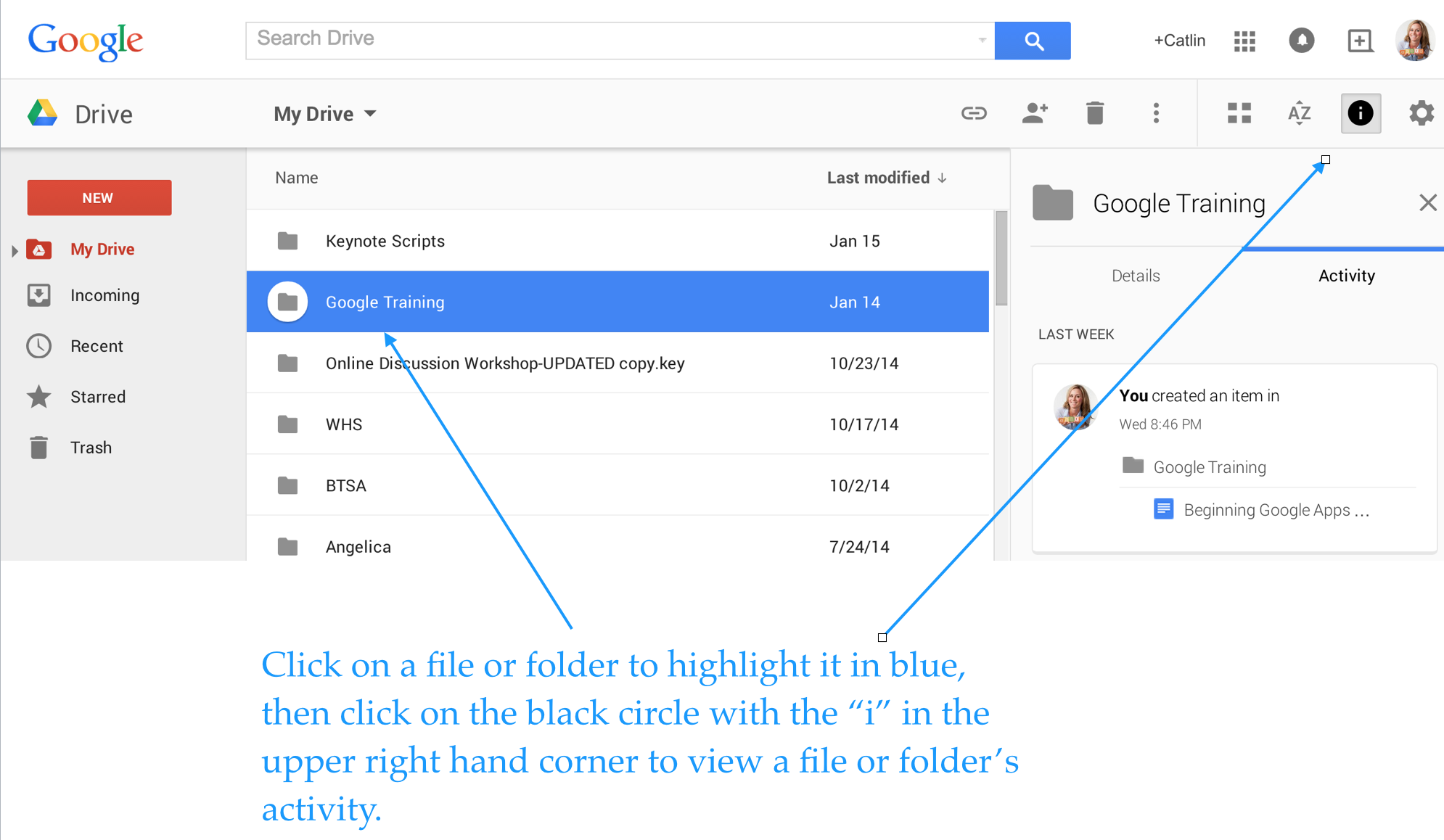
Enjoy total transparency with the “View Details” icon (black circle with the letter “i” in the middle). Simply click on a file or folder and see all of the activity associated with it. You can see when documents were created, when they were edited, and who edited them!

Screen Shot 2015-01-20 at 4.06.24 PM

Last, but not least, you can insert files, photos and videos directly from Google Drive into your emails.

Screen Shot 2015-01-20 at 1.34.37 PM

If you use Google Drive and have tips to share, please post a comment!

This post originally appeared on Catlin Tucker: Blended Learning & Technology in the Classroom and was republished with permission. 

Read all of our posts about EdTech and Innovation by clicking here. 

Standardized Testing for Colleges: A Necessary Evil?

Standardized testing in K-12 education is a perennial hot button issue. Proponents feel that measuring knowledge in these rigid ways helps lift the entire educational system. Critics say the measurements do nothing but encourage “teach to the test” methods and narrow the scope of what instructors are able to teach if they want to have acceptable test results. These arguments are nothing new, but they are now seeing a new audience.

What if the same principles of K-12 standardized testing were applied to colleges and universities? Americans spend over 0 billion on higher educational pursuits every year, yet there is no official worldwide system in place to determine whether students are learning what they should, compared to other schools. In June, the Organization for Economic Cooperation and Development unveiled research on whether a global testing system for college students is possible. The group will continue to review its findings and decide later this year if it wants to push for implementation of the Assessment of Higher Education Learning Outcomes test, abbreviated as AHELO.

Right now the comparison system for colleges and universities lies in the many rankings that are released each year by sources like U.S. News & World Report and hundreds of bloggers who weigh in on the topic. The AHELO would be a “direct evaluation of student performance at the global level…across diverse cultures, languages and different types of institutions.” It would provide institutions feedback meant to help them “foster improvement in student learning outcomes.” In a nutshell, the test would not actually measure student achievements as much as shine the light on instructors that need some improvement.

To K-12 students, this sounds familiar. To college faculty, the idea is fraught with landmines. How can one test take into account so many variables in higher education across the globe? Would instructors be punished by the institution, or even worse held to some misguided accountability scale by peers, if students did not rank highly enough on an AHELO, or some other test? If college is a time for fostering critical thinking skills, would a standardized test take away some of that freedom?

College instructors and administrators are right to have doubts, and particularly before any testing mandates go into effect. Take the classic college entrance exams – the SAT and the ACT. Though research has found little correlation between results on these tests and actual knowledge or intelligence, they are a standard part of college admissions. It is more difficult to reverse a testing mandate than to fight it off at the outset.

It is easy to see why colleges and universities are leery of standardized testing, but K-12 instructors should be too. Presently, K-12 instructors guide students through the formative education years, dealing with standardized tests and other demands of contemporary teaching. Success with those students is ultimately determined by two other numbers: graduation rate and college placement. At that point, a K-12 teacher’s job is done, at least in theory. Adding another layer of teacher testing (cleverly disguised as core knowledge testing) at the college level could have an impact on K-12 instructors too.

If the AHELO is designed to “foster improvement” in the higher education schools that are tested, who is to say that those ideals of improvement will not then be extended to the K-12 schools that came beforehand? A student who demonstrates below-college-level proficiency in language or math would in theory not be the product of college that failed him or her – that student’s incompetency would be a result of a previous school, or schools. Could a global test for college actually negatively impact the K-12 schools that preceded it?
As with any measurement of teaching and learning, the AHELO and other similar initiatives need close scrutiny before becoming global law. I am not sure of the necessity of such a system and it will take some hard arguing by the other side to convince me otherwise.

As with any measurement of teaching and learning, the AHELO and other similar initiatives need close scrutiny before becoming global law. I am not sure of the necessity of such a system and it will take some hard arguing by the other side to convince me otherwise.

Are you in favor of standardized testing in colleges and universities?

Becoming a Transformational School Leader

Though community-building takes time, its impact is long-lasting. In order to implement change in a school environment, creating a common vision is paramount. The biggest challenge for school leadership is handling different kinds of people, with various goals and interests. A school leader has to ensure that students are following curricula, excelling academically, and becoming outstanding members of society. In comparison, teachers’ are focused on meeting curricula deadlines and ensuring that students keep up with class work. The leader must confront student deviance , as well as teachers’ possible cynicism and lack of motivation.

A transformational school leader ensures students focus on their studies by being considerate of individuality, being charismatic in influencing them, and inspiring them. Instead of using set problem-solving techniques, he or she involves students and teachers to come up with solutions to problems as they arise. Transformational leaders in a school setting quickly identify areas in need of improvement, seeking out-of-the-box solutions. The leader identifies cynicism and intentions to quit among teachers, through consultation and individualized consideration. Realigning their values and goals to resonate with those of the school, the leader reassures teachers that they are needed and valued.

Emphasis in a transformational school shifts from “leadership” to “professionalism.” Direct leadership and professionalism do not mix. Studies show that professionalism cannot develop when stifled by command and instruction based leadership. Professionalism is more about competence than skill. It involves a higher degree of trust, and ensures a teacher’s commitment to caring, excellence, and to professionalism as a given.

T. J. Sergiovanni, proposed five alternative approaches to full transformational leadership in schools. These are:

• Technical leadership: sound management of school resources
• Human leadership: networking; establishing social and interpersonal bonds
• Educational leadership: expert knowledge on educational matters
• Symbolic leadership: role-modeling and behavior
• Cultural leadership: regarding the values, beliefs, and cultural identity of the school

The first three approaches—the technical, human, and educational aspects of leadership—are the primary influences on a school’s effectiveness. The symbolic and cultural aspects add the most value and are responsible for the overall excellence of the school. The traditional concept of direct leadership places an enormous burden on a school leader to run almost every aspect of leadership. Substituting a community-based approach, coupled with professionalism and cooperation, can produce speedy results. Transformational leadership can change the mindset of staff and students. Emphasis is placed on the school community, not just the leader’s interests.

Transformational leadership also brings about professionalism in the teaching staff by allowing them the autonomy and room to improve. Because a leader allows followers to meet and overcome challenges on their own, teachers are more involved in school affairs. Cooperative relationships are most likely to develop when challenges are surmounted together, without supervision from the leader.

Clearly, transformational leadership improves job performance through the four pillars of charismatic/idealized influence, individual consideration, inspirational motivation and intellectual stimulation. Studies have now shown that it also positively affects the psychological well-being of employees.

Transformational leadership helps in individual goal-setting and goal commitment, by transferring responsibility- making the individual feel part of a whole. In a shift of focus, the leader no longer offers rewards, but empowers followers to become leaders through mutual responsibility and trust. This inspires staff performance beyond leader expectations. Transformational leaders help their followers maximize performance, by finding and emphasizing common ground.

Research studies suggest that highly effective leadership styles positively influence student performance. Transformational leadership can bring about a wide range of results at a personal level (i.e., followers’ empowerment and identity) and at the group or organizational level (cohesiveness and collective power to make changes). It produces these positive effects primarily by shaping the followers’ self-worth and promoting identification with their leader.

What distinguishes a transformational leader is the combination of head and heart, and the ability to understand and apply emotions effectively to connect with and influence followers. Transformational leadership results in wide-ranging changes wherever it is introduced and is effective in solving problems in the school environment. It would be prudent for school leaders in the U.S. to utilize it in their school communities.